Monthly Archives: June 2022

What is the Ratio of Thought to Action in Biodiversity Conservation?

Many ecologists who peruse the conservation literature will come away with a general concern about the amount of effort that goes into thoughts about how conservation should be done and how much action is currently being carried out to achieve these goals in the field. My premise here is that currently the person-power given to thought greatly exceeds the person-power devoted to actually achieving the broad conservation goal of protecting biodiversity. Let me illustrate this with one dilemma in conservation: should we be concerned predominately with the loss of threatened and endangered species, or should we concentrate on the major dominant species in our ecosystems? Of course, this is not a black-or-white dichotomy, and the first answer is that we should do both. But the economist would suggest that resources are limited, and you cannot do both, so the question should be reworded as to what fraction of resources should go to one or the other of these two activities.

Consider the example of threatened and endangered species. Many of these species are rare numerically at present. In the past they may have been abundant but that is not always the case. The ecologist will know as a universal constant that most species in ecosystems are rare, and because they are rare, they are most difficult to study to answer the simple question why are they rare? Pick your favourite rare species and try to answer this question. For some species under persecution by humans the answer is simple; for most it is not, and ecologists fall back on explanations like the resources they require are not abundant, or their niche is specialized, meaningless statements that can be called panchrestons unless we have infinite time and funds to find out exactly what the limiting resources are, or why their niche is specialized. Now let us make a simple thought experiment that asks: what would happen if all these rare and endangered species disappeared from the world’s ecosystems? The first response would be total outrage that anyone would ask such a terrible question, so it is best not to talk about it. The second would be that we would be outraged if our favorite bird or frog disappeared like the passenger pigeon. The third might be that we should consider this question seriously.

Some community and ecosystem ecologists might wager that nothing would happen to ecosystem dynamics if all the rare and endangered species disappeared. No one of course would admit to such a point of view since it would end their career. At the moment we are in the unenviable state of doing the opposite experiment on the world’s coral reefs which are suffering in an ocean that is acidifying and heating up, pollution that is increasing, and overfishing that is common (Fraser et al. 2019, Lebrec et al. 2019, Romero-Torres et al. 2020). Coral reefs are an extreme example of human impacts on areas of high conservation and economic value such that the entire ecosystem will have to reconstruct itself with corals of greater tolerance to current and future conditions, a future with no clear guess of what positive effects will transpire.

Perhaps the message of both coral reef conservation and terrestrial ecosystem conservation is that you cannot destroy the major species without major consequences. Australia provides a good example of the consequences of altering predator abundance in an ecosystem. The dingo (Canis familaris) has been persecuted because of predation on sheep, and at the same time domestic cats (Felis catus) and red foxes (Vulpes vulpes) have been introduced to the continent. The ecological question is whether the reintroduction of the dingo to places where it has been exterminated will reduce the abundance of cats and foxes, and thus save naïve prey species from local extinction (Newsome et al. 2015). The answer to this question is far from clear (Morgan et al. 2017, Hunter and Letnic 2022) and may differ in different ecosystems within Australia.  

The bottom line is that our original question about rare species cannot be answered. There is much literature on introduced predators affecting food webs, following from Estes et al. (2011) important paper. and now there is much research effort on the roles of apex predators and consumers on ecosystem dynamics (Serrouya et al. 2021). Much of this effort concentrates on the common animals rather than the rare ones with which we began this discussion. Much more action in the field is needed on all conservation fronts since in my opinion the amount of thought we have available now will last field workers for the rest of the century.

Estes, J.A., Terborgh, J., Brashares, J.S., Power, M.E., Berger, J., et al. (2011). Trophic downgrading of Planet Earth. Science 333, 301-306. doi: 10.1126/science.1205106.

Fraser, K.A., Adams, V.M., Pressey, R.L., and Pandolfi, J.M. (2019). Impact evaluation and conservation outcomes in marine protected areas: A case study of the Great Barrier Reef Marine Park. Biological Conservation 238, 108185. doi: 10.1016/j.biocon.2019.07.030

Hunter, D.O. and Letnic, M. (2022). Dingoes have greater suppressive effect on fox populations than poisoning campaigns. Australian Mammalogy 44. doi: 10.1071/AM21036.

Lebrec, M., Stefanski, S., Gates, R., Acar, S., Golbuu, Y., Claudel-Rusin, A., Kurihara, H., Rehdanz, K., Paugam-Baudoin, D., Tsunoda, T., and Swarzenski, P.W. (2019). Ocean acidification impacts in select Pacific Basin coral reef ecosystems. Regional Studies in Marine Science 28, 100584. doi: 10.1016/j.rsma.2019.100584.

Morgan, H.R., Hunter, J.T., Ballard, G., Reid, N.C.H., and Fleming, P.J.S. (2017). Trophic cascades and dingoes in Australia: Does the Yellowstone wolf–elk–willow model apply? Food Webs 12, 76-87. doi: 10.1016/j.fooweb.2016.09.003.

Newsome, TM., Ballard, G.-A., Crowther, M.S., Dellinger, J.A., Fleming, P.J.S., et al. (2015). Resolving the value of the dingo in ecological restoration. Restoration Ecology 23, 201-208.  doi: 10.1111/rec.12186.

Romero-Torres, M., Acosta, A., Palacio-Castro, A.M., Treml, E.A., Zapata, F.A., Paz-García, D.A., and Porter, J.W. (2020). Coral reef resilience to thermal stress in the Eastern Tropical Pacific. Global Change Biology 26, 3880-3890. doi: 10.1111/gcb.15126

Serrouya, R., Dickie, M., Lamb, C., Oort, H. van, Kelly, A.P., DeMars, C., et al. (2021). Trophic consequences of terrestrial eutrophication for a threatened ungulate. Proceedings of the Royal Society B: Biological Sciences 288, 20202811. doi: 10.1098/rspb.2020.2811.
How Do We Decide Controversial Issues in Conservation?

While almost everyone favours conservation of plants and animals around the globe, it is far from clear how this broad goal can be disarticulated into smaller issues. Once we have done this the solution of the conservation problem should be simple. But it is not (Sutherland et al, 2021). Take an example of the koala in Australia, cute mid-size marsupials that live in trees and eat leaves. If koalas are to be protected, you must protect forests, but if you protect forests the companies that survive by logging on both private and crown land will be adversely affected. We have an immediate conflict, so how do we decide what to do. One response which we can label have-your-cake-and-eat-it-too suggests that we use some of our forests for logging and protect some forests for ecological reserves. Everyone is now happy, but things unravel. As the human population grows, we need more wood, so over time we would have to log more and more of the forested areas that could support koalas. Conflict now, jobs for loggers vs. conservation of koalas. The simplest solution is to decide all this in economic terms. Logging produces much money; conservation is largely a drain on the taxpayers. To propose that conservation should win, ecologists will pull out David Attenborough to show all the beauties of the forest and to point out that the forest contains many other animals and plants and not just trees for lumber. Stalemate, and social and economic goals begin to override the ecological issue until some compromise is suggested and accepted.

While this kind of oversimplified scenario is common, the whole issue of conservation decision making is fraught with problems and who is going to decide these issues (Christie et al. 2022)? In a democracy in the good old days, you took a vote or a poll and decided to win/lose at >50% of the vote. But this cannot work for critical problems. We have a good example of this problem now with Covid vaccination requirements, and a vocal minority opposed to vaccinations. This now spills over into the issue of whether to wear a face mask or not. In all these kinds of scenarios science delivers a simple decision about the consequences of decision A vs decision B, but the problem is that society can refuse to recognize the scientific results or just prefer decision B with little visible justification. Science is not always perfect, adding further complications. And in the case of the covid virus, the virus can mutate in unexpected ways, complicating prognoses. In the case of protected conservation areas, we can suffer fires, floods, insect outbreaks and any number of events that affect the balance of decision making.

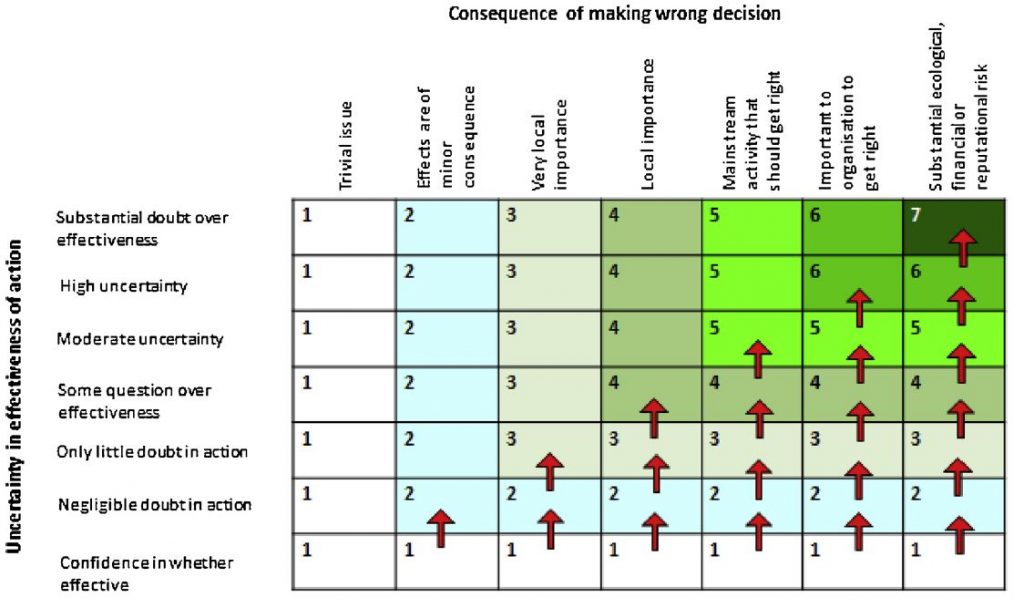
There is a large literature on decision making in conservation (e.g., Bower et al. 2018) and even good advice from the field of psychology about this problem of making decisions (Papworth 2017). The best systematic decision tree I have found is that in Sutherland et al. 2021). Sutherland et al. (2021) compiled a framework that can be used profitably in deciding on the level of evidence assessment (see Table 1 and Figure 1 below from their paper).

Table 1 and Figure 1 from Sutherland et al. (2021)

The Strategic Evidence Assessment Framework. Seven levels of evidence assessment, how to apply them.

Assessment LevelApproach UsedGeneral Database ApplicationApproximate Time to reflect on the evidence
1 No consideration of evidenceContinue with existing practice or make decisions without considering scientific evidencenone
2 Assertion but no independent consideration of evidenceConsultation with others (including experts) that affect decision but are not verified e.g. “we normally do this”, “accepted best practice is to do this”minutes
3Papers reviewed, looking at: Read the title and/or summary points to determine whether action described in the paper is likely to be effective or not. Review effectiveness category e.g. “likely to be beneficial” on action page to decide whether action is likely to be effective or notminutes
4 Read abstract to assess the evidence described in the paper in relation to the local problemTens of minutes- hours
5  Read abstract, key results and conclusion assessing each paper in relation to the decision being madeHours
6 Read the full underlying paper/s. This is likely to affect decisions on study quality, relevance and modificationsHours to days
7Comprehensive assessmentA systematic review of all available literature. Assessed papers summarised as part of new reviewMonths to a year

Figure 1. A framework for considering the appropriate level of effort in decision making. Numbers refer to assessment level (Table 1). For a given decision about an action identify the column with the relevant level of consequence, start at the lowest level (1) and decide whether it would benefit from examining higher levels of evidence. Keep moving up until either the uncertainty in the effectiveness of the action is resolved from examining the evidence (from any platform) or the arrows end. This final number is the level at which the evidence assessment should occur. (From Sutherland et al. 2021 with permission).

Clearly conservation ecologists cannot use the highest assessment level for all issues that arise and must result to triage in many cases (Hayward and Castley 2018). But triage and assessment levels 1 and 2 should be rare in making judgement on what program to adopt. We need to get the science right for all conservation problems.

But this is not enough to get thoughtful political decisions. Some native species can be pests, yet nothing is done to reduce their damage (e.g. horses in North America and Australia, camels and goats in Australia, feral pigs in North America) and the list goes on. Nothing is done because of budget limitations or political concerns about “cute species”. The science of conservation is difficult enough, the social science of conservation is too often out of our control.

Bower, S.D., Brownscombe, J.W., Birnie-Gauvin, K. Ford, M.I. et al. (2018). Making Tough Choices: Picking the appropriate conservation decision-making tool. Conservation Letters 11, e12418. doi: 10.1111/conl.12418.

Christie, A.P., Downey, H., Bretagnolle, V., Brick, C., Bulman, C.R., et al. (2022). Principles for the production of evidence-based guidance for conservation actions. Conservation Science and Practice 4, e579. doi: 10.1111/csp2.12663.

Hayward, M.W. and Castley, J.G. (2018). Triage in Conservation. Frontiers in Ecology and Evolution 5, 168. doi: 10.3389/fevo.2017.00168.

Papworth, Sarah (2017). Decision-making psychology can bolster conservation. Nature Ecology & Evolution 1, 1217-1218. doi: 10.1038/s41559-017-0281-9.

Sutherland, W.J., Downey, H., Frick, W.F., Tinsley-Marshall, P., and McPherson, T. (2021). Planning practical evidence-based decision making in conservation within time constraints: the Strategic Evidence Assessment Framework. Journal for Nature Conservation 60, 125975. doi: 10.1016/j.jnc.2021.125975.

What Can You Do About the Climate Emergency?

It is very easy to do little in the climate emergency because it is a long-term problem, and many of us will be gone by 2050 when Shell Oil and our government promise Net Zero emissions. Possibly the first thing you should do is find out what “net zero” really means. “Net zero emissions” refers to achieving an overall balance between greenhouse gas emissions produced by us and greenhouse gas emissions taken out of the atmosphere. So clearly it does not mean zero emissions so pollution will still be with us, and all it promises is equality between what goes in and what comes out. If you believe that net-zero will happen, you are living in la-la land, but consider it a scientific hypothesis and if you are young and live to 2050, check the numbers. It means that all the greenhouse gases that are here today will remain and all the problems on our doorstep today will continue – floods, fires, drought, sea level rise, agricultural changes, temperature increases – and if you think none of this will bother you, you can probably buy an inexpensive house in New Mexico and avoid shopping for groceries.

But do not throw your hands up since there are many small things all of us can do to minimize these problems. Here is a partial list:

  1. Drive less, fly less, walk more, get an electric car if you can. Try a bicycle.
  2. Avoid coal, gasoline, and natural gas implements. Sit in the sun, not under a propane heater on the deck.
  3. Put solar panels on your roof if you can. In addition to your windmill generating power.
  4. Put your retirement funds into renewable energy funds, not into oil companies.
  5. Educate yourself and ignore all the dangerous nonsense about climate change that is provided in advertisements, radio, TV, and social media.
  6. Protest against climate nonsense by writing letters, using social media, phoning the stations that allow nonsense to be perpetrated. Your one letter may have minimal effect, but if a million people do the same, someone might listen.
  7. Demand that politicians actually answer questions about climate change action plans. And as they say in Chicago, vote early and vote often.
  8. Nominate Greta Thunberg again for the Nobel Prize. If she does not receive it, request that the Nobel Committee be disbanded and replaced by young people.
  9. Relax and enjoy your life while keeping a lid on your carbon budget.

The climate emergency is not difficult to comprehend. Help the world survive it for your grandchildren.

Our World View and Conservation

Recent events have large implications for conservation science. Behind these events – Covid, climate change, wars – lies a fundamental dichotomy of views about humanity’s place in the world today. At the most basic level there are those who view humans as the end-all-and-be-all of importance so that the remainder of the environment and all other species are far down the list of importance when it comes to decision making. The other view is that humans are the custodians of the Earth and all its ecosystems, so that humans are an important part of our policy decisions but not the only part or even the most important part. Between these extreme views there is not a normal distribution but a strongly bimodal one. We see this very clearly with respect to the climate emergency. If you explain the greenhouse dilemma to anyone, you can see the first reaction is that this does not apply to me, so I can do whatever I want versus the reaction of others that I should do something to reduce this problem now. It is the me-here-and-now view of our lives in contrast to the concern we should have about future generations.

Our hope lies in the expectation that things are improving, strongly in young people, more slowly in older people, and negligibly in our politicians. We must achieve sustainability professed by the Greta Thunberg’s of the world, and yet recognize that the action needed is promised by our policy makers only for 2050 or 2100. There is hope that the captains of industry will move toward sustainability goals, but this will be achieved only by rising public and economic pressure. We are beset by wars that make achieving any sustainability goals more difficult. In Western countries blessed with superabundant wealth we can be easily blinded by promises of the future like electricity from nuclear fusion at little cost, or carbon-capture to remove greenhouse gases from the atmosphere. If things get impossibly bad, we are told we can all go to Mars. Or at least the selected elite can.

Conservation gets lost in this current world, and pleas to set aside 30% or 40% of the Earth for biosphere conservation are rarely even heard about on the evening news. The requests for funds for conservation projects are continually cut when there are more important goals for economic growth. Even research funding through our first-class universities and government laboratories is falling, and I would wager without the data that less than 20% of funding for basic research goes to investigating environmental problems or conservation priorities. In my province in Canada a large section of this year’s budget labelled “Addressing Climate Change” is to be spent on repairing the highways from last year’s floods and trying to restore the large areas affected by fires in the previous dry summer.  

What is the solution to this rather depressing situation? Two things must happen soon. First, we the public must hold the government to account for sustainability. Funding oil companies, building pipelines, building highways through Class A farmland, and waging wars will not bring us closer to having a sustainable earth for our grandchildren. Second, we must encourage private industries and wealthy philanthropists to invest in sustainability research. Conservation cannot ever be achieved without setting aside large, protected areas. The list of species that are in decline around the Earth is growing, yet for the vast number of these we have no clear idea why they are declining or what can be done about it. We need funding for science and action, both in short supply in the world today. And some wisdom thrown in.