Monthly Archives: January 2020

On the Rules of Civilization in 2020

We are all citizens of the Earth, so we will start with the single assumption that we wish to protect the Earth for our children and grandchildren, If you do no agree with this assumption we hope you will find life on Mars to be more congenial. If you are content with life on Earth, please observe these rules.

  1. Listen to Greta, in English or Swedish.
  2. For further guidance join 350.org. https://350.org/about/   
  3. If you think the present climate crisis is a minor problem, please read David Wallace-Wells’ book (2019). 
  4. If you are an old person (>45 years) go to (9) below. If you are a young person, keep reading.
  5. The world is a mess and it is not your fault. Do not give up. Become active. Vote. Go to political meetings and ask questions.
  6. Ask about policies at the local, regional, and national level. How is this policy – this war, this new freeway, this new oil pipeline – helping to solve the Earth’s climate crisis.
  7. Do not take business-as-usual for an answer to your questions. Challenge the system to do better.
  8. Work to make voting compulsory. That would begin to ensure democracy. Cut the voting age to 16. Work for proportional representation. You must design a fool-proof world. We have failed to do so.
  9. If you are an older person and at least 45 years old, realize that half or more of your life is over. You have time now to atone for your environmental sins of the past and to work hard to protect the Earth for the young people. Read Stiglitz (2012) or Reich (2018).
  10. Support strong legislation. For many policies we old people should not have a vote. At best to be nice to the elderly, perhaps our vote should count in the reverse proportion of age/100, so a 50 year old would have ½ a vote, and a 75 year old would have ¼ a vote relative to the young people who will inherit the planet.  
  11. Stop supporting the electoral parties who have made the environment a mess. Demand real sustainability, not nonsense policies.
  12. Encourage taxes on wealth. No matter what you may think, you cannot take it with you. Believe it or not, there are countries on Earth with good policies for people and for the environment. Mimic the good. Shame the bad.
  13. If you wish to be radical, vote for policies that provide the highest salaries and lowest taxes to nurses, doctors, teachers, and social workers, and the lowest salaries and highest taxes to CEOs, politicians, lawyers, economists, and TV personalities.
  14. Work for equality in the world, and remember that you as an individual are important, but you are not the most important person in the world. We already know who that is.

Reich, R. (2018). Saving Capitalism: For the Many, Not the Few. 219 pp. ISBN: 978-0-385-35057-0)

Stiglitz, J.E. (2012) ‘The Price of Inequality.’ W.W. Norton and Company: New York. 560 pp. ISBN: 978-0-393-34506-3

Wallace-Wells, David (2019) ‘The Uninhabitable Earth: Life After Warming ‘ Tim Duggan Books: New York. 304 pp. ISBN: 978-0-525-57670-9.  

On Rice and Climate Change

After I retired, I was privileged to be able to team-teach a short course in pest management at the International Rice Research Institute at Los Baños in the Philippines. The course was run by Grant Singleton and David Johnson and was taught every second or third year to about 30 young scientists from Southeast Asia who were mostly concerned about rice cultivation, rodent pests and weeds in rice. The course was an eye-opener for me both to the world of rice, the extensive and excellent research going on at IRRI on rice cultivation, and the very bright and enthusiastic young scientists from Southeast Asia, many of which had never traveled outside their home country before taking this course.

Why should we worry about rice? Rice is the staple food of at least 4 billion people on Earth. That is one clear message that defines its importance for humans. When I was revising my ecology textbook some years ago, one of the reviewers complained about all the material on rice in my book and asked why I did not use more North American crops for examples. We should not be this short-sighted. Population growth and food security are now front-page issues on every continent, and scientists at IRRI (established in 1960 and now with more than 1000 staff) continue to do research with the goal of improving the yield of rice varieties and the livelihood of rice farmers around the world. Much of IRRI’s research has involved developing and improving varieties of rice to make them more productive, and our ecological goal in teaching about the ecology of pest management was to suggest ways of reducing losses to rice pests that could range from 15-40% of the total crop (Htwe et al. 2019). But as IRRI scientists realized long ago, the quality of the rice crop is as important as the quantity.

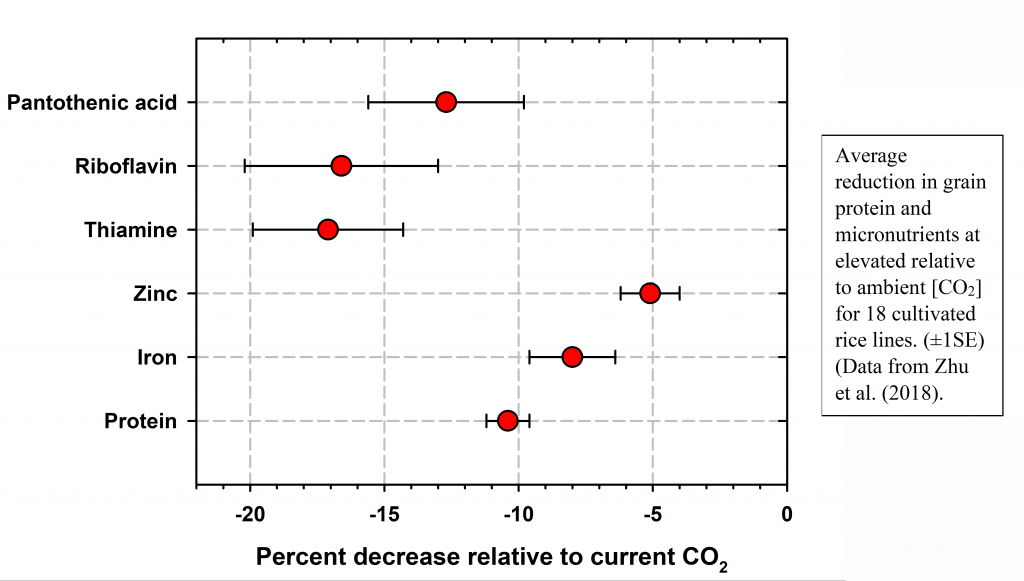
Whither rice cultivation in a world of climate change? Changing temperature and rainfall are key concerns for all crops but nutritional value is another. Zhu et al. (2018) have reviewed the possible effects of rising CO2 on the nutritional value of rice. The answer is not good. At many different sites Zhu et al. (2018) grew 18 varieties of rice in FACE (Free Air CO2 Enriched) experiments and measured the changes in the quality of the rice in protein and vitamin content. Current levels of CO2 are about 410 ppm, and in their experiments, they increased CO2 to 570-590 ppm (the level expected within this century). One graph illustrates their main results:

Folate (vitamin B12) is not shown because it is off the graph at -30.3% decrease.

About 600 million people, primarily in Southeast Asia, consume ≥50% of their per capita dietary energy and/or protein directly from rice (Smith and Myers 2019). The concern is that even small losses of these vitamins in rice caused by higher CO2 could have potentially large impacts on global health, placing tens of millions of people at new risk of deficiencies in one or more of these nutrients. Singer et al. (2019) review the main biotechnological research strategies that are currently underway with the aim of improving photosynthetic efficiency and biomass production/yields in the context of a future of rising CO2. Rising temperatures change the developmental processes of plants and the key for crops is artificial selection for varieties more adapted to warm temperature but for wild plants only relatively slow natural selection is available to achieve the same goals, which may well increase the rate of extinction of our native plants without some intervention (Lippmann et al. 2019).

Another issue that is behind rice cultivation as well as all modern agriculture is soil nutrient conservation. At IRRI they grew several rice varieties for demonstration purposes, cultivating them on rich volcanic soils. One of their treatment plots was a control – no fertilizers were added, and the same unchanged rice variety was used each year. One of the results of these demonstration plots was that the control plot, which we had assumed should be stable and sustainable, was declining in rice production per ha at a rate of 1-2% per year. During the 38-year study (1968-2005) climate was changing, CO2 was increasing, air pollution may have changed, so that soil productivity is only one possible explanation of these declining rice yields. Slow changes in soil fertility are difficult to track and yet vitally important in the long run if we are to have sustainable agriculture under climate change and human population growth. Now it is clear that we not only need to maintain soil fertility in agricultural soils for high productivity but also need to be concerned about high quality of the grains and vegetables being produced in a climate-changing world. We do not live in a constant environment and can no longer assume stability in the quality of our food supplies.

Htwe, Nyo Me, Singleton, G.R. and Johnson, D.E. (2019). Interactions between rodents and weeds in a lowland rice agro-ecosystem: the need for an integrated approach to management. Integrative Zoology 14, 396-409. doi: 10.1111/1749-4877.12395

Lippmann, R. et.al. (2019). Development of wild and cultivated plants under global warming conditions. Current Biology 29, R1326-R1338. doi: 10.1016/j.cub.2019.10.016

Singer, S.D. et al. (2019). Biotechnological strategies for improved photosynthesis in a future of elevated atmospheric CO2. Planta 251, 24. doi: 10.1007/s00425-019-03301-4.

Smith, M.R. and Myers, S.S. (2019). Global health implications of nutrient changes in rice under high atmospheric carbon dioxide. Geohealth 3, 190-200. doi: 10.1029/2019GH000188

Zhu, C. et al. (2018). Carbon dioxide (CO2) levels this century will alter the protein, micronutrients, and vitamin content of rice grains with potential health consequences for the poorest rice-dependent countries. Science Advances 4, eaaq1012. doi: 10.1126/sciadv.aaq1012 

On Declining Bird Populations

The conservation literature and the media are alive with cries of declining bird populations around the world (Rosenberg et al. 2019). Birds are well liked by people, and an important part of our environment so they garner a lot of attention when the cry goes out that all is not well. The problems from a scientific perspective is what evidence is required to “cry wolf’. There are many different opinions on what data provide reliable evidence. There is a splendid critique of the Rosenberg et al paper by Brian McGill that you should read::
https://dynamicecology.wordpress.com/2019/09/20/did-north-america-really-lose-3-billion-birds-what-does-it-mean/

My object here is to add a comment from the viewpoint of population ecology. It might be useful for bird ecologists to have a brief overview of what ecological evidence is required to decide that a bird population or a bird species or a whole group of birds is threatened or endangered. One simple way to make this decision is with a verbal flow chart and I offer here one example of how to proceed.

  1. Get accurate and precise data on the populations of interest. If you claim a population is declining or endangered, you need to define the population and know its abundance over a reasonable time period.

Note that this is already a nearly impossible demand. For birds that are continuously resident it is possible to census them well. Let me guess that continuous residency occurs in at most 5% or fewer of the birds of the world. The other birds we would like to protect are global or local migrants or move unpredictably in search of food resources, so it is difficult to define a population and determine if the population as a whole is rising or falling. Compounding all this are the truly rare bird species that are difficult to census like all rare species. Dorey and Walker (2018) examine these concerns for Canada.

The next problem is what is a reasonable time period for the census data. The Committee on the Status of Endangered Wildlife in Canada (COSEWIC) gives 10 years or 3 generations, whichever is longer (see web link below). So now we need to know the generation time of the species of concern. We can make a guess at generation time but let us stick with 10 years for the moment. For how many bird species in Canada do we have 10 years of accurate population estimates?

  • Next, we need to determine the causes of the decline if we wish to instigate management actions. Populations decline because of a falling reproductive rate, increasing death rate, or higher emigration rates. There are very few birds for which we have 10 years of diagnosis for the causes of changes in these vital rates. Strong conclusions should not rest on weak data.

The absence of much of these required data force conservation biologists to guess about what is driving numbers down, knowing only that population numbers are falling. Typically, many things are happening over the 10 years of assessment – climate is changing, habitats are being lost or gained, invasive species are spreading, new toxic chemical are being used for pest control, diseases are appearing, the list is long. We have little time or money to determine the critical limiting factors. We can only make a guess.

  • At this stage we must specify an action plan to recommend management actions for the recovery of the declining bird population. Management actions are limited. We cannot in the short term alter climate. Regulating toxic chemical use in agriculture takes years. In a few cases we can set aside more habitat as a generalized solution for all declining birds. We have difficulty controlling invasive species, and some invasive species might be native species expanding their geographic range (e.g. Bodine and Capaldi 2017, Thibault et al. 2018).

Conservation ecologists are now up against the wall because all management actions that are recommended will cost money and will face potential opposition from some people. Success is not guaranteed because most of the data available are inadequate. Medical doctors face the same problem with rare diseases and uncertain treatments when deciding how to treat patients with no certainty of success.

In my opinion the data on which the present concern over bird losses is too poor to justify the hyper-publicity about declining birds. I realize most conservation biologists will disagree but that is why I think we need to lift our game by having a more rigorous set of data rules for categories of concern in conservation. A more balanced tone of concern may be more useful in gathering public support for management efforts. Stanton et al. (2018) provide a good example for farmland birds. Overuse of the word ‘extinction’ is counterproductive in my opinion. Trying to provide better data is highly desirable so that conservation papers do not always end with the statement ‘but detailed mechanistic studies are lacking’. Pleas for declining populations ought to be balanced by recommendations for solutions to the problem. Local solutions are most useful, global solutions are critical in the long run but given current global governance are too much fairy tales.

Bodine, E.N. and Capaldi, A. (2017). Can culling Barred Owls save a declining Northern Spotted Owl population? Natural Resource Modeling 30, e12131. doi: 10.1111/nrm.12131.

Dorey, K. and Walker, T.R. (2018). Limitations of threatened species lists in Canada: A federal and provincial perspective. Biological Conservation 217, 259-268. doi: 10.1016/j.biocon.2017.11.018.

Rosenberg, K.V., et al. (2019). Decline of the North American avifauna. Science 366, 120-124. doi: 10.1126/science.aaw1313.

Stanton, R.L., Morrissey, C.A., and Clark, R.G. (2018). Analysis of trends and agricultural drivers of farmland bird declines in North America: A review. Agriculture, Ecosystems & Environment 254, 244-254. doi: 10.1016/j.agee.2017.11.028.

Thibault, M., et al. (2018). The invasive Red-vented bulbul (Pycnonotus cafer) outcompetes native birds in a tropical biodiversity hotspot. PLoS ONE 13, e0192249. doi: 10.1371/journal.pone.0192249.

http://cosewic.ca/index.php/en-ca/assessment-process/wildlife-species-assessment-process-categories-guidelines/quantitative-criteria

On Fires in Australia

The fires of Australia in their summer 2019-20 are in the news constantly, partly because the media survive on death and destruction and partly because to date we have never seen a whole continent burn up. It is hardly a ‘Welcome to the Anthropocene”  kind of event to celebrate, and the northern media display the fires as nearly all news of the Southern Hemisphere is treated, something unusual, often bad, but of no general importance to the real world of the Northern Hemisphere.

What do we hear from a cacophony of public opinion?

“Nothing unusual. We have always had fires in the past. Why in 1863…..”
“Nothing to do with climate change. Climate has always been changing….(see point 1)
“Main cause had been Green Policies. If we had more forestry, there would have been many fewer trees to burn….”
“Inadequate controlled burning because of the Greens’ policies….(see point 3)
“Why doesn’t the Government do something about this?”
“Fortunately these fires are a rare event and not likely to occur again…….

In reply an ecologist might offer these facts:

  1. Much research by plant geographers and ecologists have shown how many plant communities are dominated by fire. The boreal forest is one, the chaparral of Southern California is another, the grasslands of Africa and the Great Plains of the USA are yet more.
  2. By preventing fire in these communities over time the fuel load builds up so that, should there be a subsequent fire, the fire severity would be very high.
  3. By building houses, towns, and cities in these plant communities fire danger increases, and an active plan of fire management must be implemented. Most of these plans are effective for normal fires but for extreme conditions no fire management plan is effective.
  4. Climate change is now producing extreme conditions that were once very rare but are now commonly achieved. With no rainfall, high winds, and temperatures over 40-45ºC fires cannot be contained. Severe fires generate their own weather that accelerates fire spread with embers being blown kilometers ahead of the active fire front.
  5. The long-term plan to have controlled patch burns to relieve these fire conditions are impossible to implement because they require no wind, low temperatures, and considerable person-power to prevent controlled burns getting away from containment lines should the weather change.

Since a sizeable fraction of dangerous fires are deliberately set by humans, methods to detect and prevent this behaviour could help in some cases. Infrastructure such as power lines could be upgraded to reduce the likelihood of falling power poles and lines shorting out. All this will cost money, and the less the fire frequency, the fewer the people willing to pay more taxes to reduce public risk. Some serious thinking is needed now because Australia 2020 is just the start of a century of fire, drought, floods, and high winds. We do not need the politicians of 2050 telling us “why didn’t someone warn us?

There is a very large literature on fire in human landscapes (e.g. Gibbons et al. 2012), and I include only a few references here. They illustrate that the landscape effects of fire are multiple and area specific. Much more field research is needed, and landscape ecology has a vital role to play in understanding and managing the interface of humans and fire.

Badia, A. et al. (2019). Wildfires in the wildland-urban interface in Catalonia: Vulnerability analysis based on land use and land cover change. Science of The Total Environment 673, 184-196. doi: 10.1016/j.scitotenv.2019.04.012.

Gibbons, P, et. al. (2012) Land management practices associated with house loss in wildfires. PLoS ONE 7(1): e29212. https://doi.org/10.1371/journal.pone.0029212

Gustafsson, L. et al. (2019). Rapid ecological response and intensified knowledge accumulation following a north European mega-fire. Scandinavian Journal of Forest Research 34, 234-253. doi: 10.1080/02827581.2019.1603323.

Minor, J. and Boyce, G.A. (2018). Smokey Bear and the pyropolitics of United States forest governance. Political Geography 62, 79-93. doi: 10.1016/j.polgeo.2017.10.005.

Ramage, B.S., O’Hara, K.L., and Caldwell, B.T. (2010). The role of fire in the competitive dynamics of coast redwood forests. Ecosphere 1(6), art20. doi: 10.1890/ES10-00134.1.

On Progress in Ecology

We are in ecology continually discussing what progress we are making in answering the central questions of our science. For this reason, it is sometimes interesting to compare our situation with that of economics, the queen of the social sciences, where the same argument also continues. A review by David Graeber (2019) in the New York Review of Books contains some comments about the ‘theoretical war’ in economics that might apply to some ecology subdisciplines. In it he discusses the arguments in social science between two divergent views of economics, that of the school of Keynesians and that of the now dominant Neoclassical School led by Frederich Hayek and later by Milton Friedman and many others of the Chicago School. John Maynard Keynes threw down a challenge illustrated in this quote from Graeber (2019):

“In other words, ‘(Keynes)’ assumed that the ground was always shifting under the analysts’ feet; the object of any social science was inherently unstable. Max Weber, for similar reasons, argued that it would never be possible for social scientists to come up with anything remotely like the laws of physics, because by the time they had come anywhere near to gathering enough information, society itself, and what analysts felt was important to know about it, would have changed so much that the information would be irrelevant. (p. 57)”

Precise quantitative predictions could be provided by simplified economic models, the Chicago School argued in rebutting Keynes. Graeber (2019) comments:

“Surely there’s nothing wrong with creating simplified models. Arguably, this is how any science of human affairs has to proceed. But an empirical science then goes on to test those models against what people actually do, and adjust them accordingly. This is precisely what economists did not do. Instead, they discovered that, if one encased those models in mathematical formulae completely impenetrable to the noninitiate, it would be possible to create a universe in which those premises could never be refuted. (“All actors are engaged in the maximization of utility. What is utility? Whatever it is that an actor appears to be maximizing.”) The mathematical equations allowed economists to plausibly claim theirs was the only branch of social theory that had advanced to anything like a predictive science.  (p. 57)”

In ecology the major divergence between schools of thought promoting progress have never been quite this distinct. Shades of complaint are evident in the writings of Peters (1991) and a burst of comment after that ranged from optimism (e.g. Bibby 2003) to more support for Peter’s critique (Underwood et al. 2000, Graham and Dayton 2002). Interest at this time seems to have waned in favour of very specific topics for review. If you check the Web of Science for the last 5 years for “progress” and “ecology” you will find reviews of root microbes, remote sensing of the carbon cycle, reintroduction of fishes in Canada and a host of very important reviews of small parts of the broad nature of ecology. As Kingsland (2004, 2005) recognized, ecology is an integrating science that brings together data from diverse fields of study. If this is correct, it is not surprising that ecologists differ in answering questions about progress in ecology. We should stick to small specific problems on which we can make detailed studies, measurements, and experiments to increase understanding of the causes of the original problem.

One of the most thoughtful papers on progress in ecology was that of Graham and Dayton (2002) who made an important point about progress in ecology:

“We believe that many consequences of ecological advancement will be obstacles to future progress. Here we briefly discuss just a few: (1) ecological specialization; (2) erasure of history; and (3) expansion of the literature. These problems are interconnected and have the potential to divert researchers and hinder ecological breakthroughs.” (p. 1486)

My question to all ecologists is whether or not we agree with this ‘prediction’ from 2002. There is no question in my judgement that ecology is much more specialized now, that history is erased in spite of search engines like the Web of Science and that the ecology literature is booming so rapidly that it feeds back to ecological specialization. There is no clear solution to these problems. The fact that ecology is integrative has developed into a belief that anyone with a little training in ecological science can call themselves an ecologist and pontificate about the problems of our day. This element of ‘fake news’ is not confined to ecology and we can counter it only by calling out errors propagated by politicians and others who continue to confuse truth in science with their uneducated beliefs.

Bibby, C.J. (2003). Fifty years of Bird Study. Bird Study 50, 194-210. Doi: 10.1080/00063650309461314.

Graham, M.H. and Dayton, P.K. (2002). On the evolution of ecological ideas: paradigms and scientific progress. Ecology 83, 1481-1489. Doi: 10.1890/0012-9658(2002)083[1481:OTEOEI]2.0.CO;2.

Graeber, D. (2019). Against Economics. New York Review of Books 66, 52-58. December 5, 2019.

Kingsland, S. (2004). Conveying the intellectual challenge of ecology: an historical perspective. Frontiers in Ecology and the Environment 2, 367-374. Doi: 10.1890/1540-9295(2004)002[0367:CTICOE]2.0.CO;2.

Kingsland, S.E. (2005) The Evolution of American Ecology, 1890-2000. Johns Hopkins University Press: Baltimore. 313 pp. ISBN 0801881714

Peters, R.H. (1991). A Critique for Ecology. Cambridge University Press: Cambridge, England. 366 pp. ISBN:0521400171

Underwood, A.J., Chapman, M.G., and Connell, S.D. (2000). Observations in ecology: you can’t make progress on processes without understanding the patterns. Journal of Experimental Marine Biology and Ecology 250, 97-115. Doi: 10.1016/S0022-0981(00)00181-7.