
Two steps forward -- one step back:
The pleiotropic effects of favored alleles
"As a result of complex biochemical, developmental, and regulatory pathways, a single gene will almost always influence multiple traits, a phenomenon known as pleiotropy (Wright 1968)."
- Lynch and Walsh (1998)
What can we say about the magnitude of pleiotropic effects that occur as alleles rise in frequency through selection for a specific trait?
Doebley et al. (1995) examined the effects of two QTLs on morphological differences between teosinte and maize.

 QTLs had significant effects on 9/9 and 8/9 traits measured!
Scenario: Consider a trait subject to a novel selective pressure.
An allele that positively affects the trait under selection will experience a direct selective advantage (sd) as well as pleiotropic selection (sp) for a total selection coefficient of sT.
Claim: Just as most mutations that affect fitness are deleterious, we would expect the total pleiotropic effects of an allele to negatively affect fitness (sp < 0).
But what distribution will sp follow?
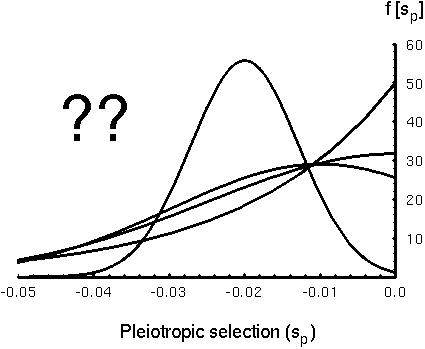
Can we say anything general about the extent of pleiotropy expected among favorable alleles?
Let f[sp] represent the distribution of pleiotropic effects.
The chance that an allele will be favorable overall (sT > 0) equals:

where the approximation assumes that direct selection is weak.
Among these beneficial alleles, the strength of counter-acting pleiotropic selection is:

which does not depend on the unknown mean of the distribution of pleiotropic effects!!
When direct selection is weak, pleiotropy will cause the total selection on beneficial alleles to be roughly halved.
Assumptions:

WHY?
The uniform distribution offers a clue!!

New Mutations: If new mutations are the source of genetic variation, not only must sT be positive, but the mutations must also fix, which is more probable for larger values of sT.
The chance that an allele fixes is reduced to sd2 f[0].
Among fixable mutations, the average pleiotropic effect on fitness is -sd/3.
"The available evidence indicates that pleiotropy is virtually universal."
- Wright (1968)
This work provides null expectations for the effects on fitness of pleiotropy.
1. Pleiotropy will cause evolutionary inertia, reducing the chance that alleles will spread in response to weak directional selection.
| In artificial selection experiments, realized heritability should be lower than expected, especially when selection intensity is low. |

|
2. Pleiotropy will roughly halve the total strength of selection for alleles that spread within a population in response to weak directional selection.
| In artificial selection experiments, the response to relaxed selection should be similar in slope, but opposite in direction. |

|
3. It may be hard to identify, in hindsight, the exact traits that have been favored by natural selection, since a suite of phenotypic changes, even costly ones, may have arisen pleiotropically.