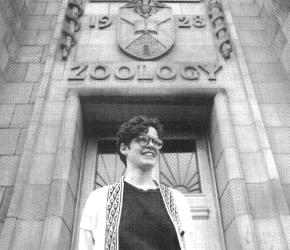
 Full Professor
 Visit Dr. Otto's home page
My work focuses on the development of population-genetic models, using analytical and numerical techniques to infer what evolutionary changes are possible and under what conditions. The goals of this research are to produce specific predictions that can be tested either experimentally or by comparing the expected and observed distributions of a trait. I am currently interested in combining theoretical and empirical approaches to a variety of questions including:
How does the balance between haploid and diploid phases of a life cycle evolve? The haploid and diploid phases of sexual life cycles are extremely variable in length, ranging from little development in one or the other phase to equal development in both. Evolutionary models are being explored to better understand the factors that favor different life cycles. These models include characteristics of a population such as its mating system, ecology, and population size.
Why has recombination evolved? This question has been of central interest to evolutionists for some time, yet we still do not know the answer. Theoretical analyses have found that evolution can favor increased recombination, but that it often favors decreased recombination. The essential problem is that recombination acts as a double-edged sword, both creating and destroying advantageous gene combinations. I am exploring a variety of possible advantages of recombination to determine which favors recombination most strongly and over the broadest range of parameters.
What factors affect the rate of evolution of a population? Demographic factors can have a large impact on the rate of adaptive evolution of a population. Similarly, changes in population size affect the amount of genetic drift, the extent to which deleterious mutations accumulate, and the maintenance of genetic variation. We are investigating the role that a number of factors, including demography, have on the evolutionary potential of a population.
Otto, S. P. and C. D. Jones (2000) Detecting the undetected: Estimating the total number of loci underlying a trait in QTL analyses. Genetics, 156: 2093-2107.
Otto, S. P. and B. Mable (1998) The evolution of life cycles with haploid and diploid phases. BioEssays, 20: 453-462.
Otto, S. P. and M. C. Whitlock (1997) The probability of fixation in populations of changing size. Genetics, 146:723-733.
Cummings, M., S. P. Otto, and J. Wakeley (1995) The sampling properties of DNA sequence data in phylogenetic analysis. Molecular Biology and Evolution, 12:814-822.