|

Measuring
metabolic
rates
|

Steller sea lion research
>
Nutritional Stress >Effects of
Diet Changes >Physiological Measures
Physiological Measures and the health of Steller sea lions
Researchers have been using a number of different methods to study
the effect of different diets on the physical condition and health of
Steller sea lions. One is to measure morphology, such as the length, weight
and thickness of the blubber layer. Another is to assess the nutritional
status from hormones and other elements contained within blood samples,
in the same way that doctors can tell a lot about human health by drawing
a sample of blood. Some of these studies are conducted on wild Steller
sea lions in the wild and others use a group of trained sea lions in captivity.
Diet Manipulations
In the wild, Steller sea lions eat a number of different types of fish
and invertebrates. Recent scientific research suggests that the type of
prey available to Steller sea lions in the North Pacific may be changing.
Different prey, such as herring or pollock, provide different amounts
of energy to the animal. (see Assessing Prey Quality)
To help determine the possible effects of diet changes, the regular diet
of the sea lions at the Vancouver Aquarium was switched from herring to
Atka Mackerel pollock and squid, which have less energy. Changes in the
food intake, body mass, and metabolism of the sea lions are then carefully
monitored. Results indicate that lower quality prey, such as pollock,
requires more energy to digest than a higher quality diet of herring.
Additionally, the sea lions appear unable to maintain body mass when switched
to a lower calorie prey such as squid or pollock, and need to compensate
by conserving energy. It appears that the sea lions do not compensate
for low energy food sources by increasing their food intake. Instead they
seem to use up more of their own energy stores (i.e., they lose weight),
and they spend less energy (i.e., they lower their resting metabolism).
Dr. Rosen (UBC) has been assessing the metabolic adaptations employed
to combat periods of low food intake. Additional data have been collected
on how body composition changes during periods of fasting. Initial results
suggest that sea lion's physiological response to low-food conditions
may be both seasonal and age-dependent.

Morphology
One way of estimating the health or condition of a pinniped is to measure
the thickness of the layer of blubber that lies just below the skin. Calipers
measure skinfold thickness and provide a reliable estimate of fat thickness
in humans. Researchers Andrew Trites (UBC) and Remko Jonker (UBC) sought
to determine whether this simple and inexpensive device could be used
to measure the condition of Steller sea lion pups in the wild. They measured
the skinfold thickness of dead pups found on the breeding beaches of Alaska.
They discovered that heavy pups had higher skinfold thickness than lighter
pups. However, this relationship was true for pups with blubber as well
as pups that had died of starvation (no blubber). Therefore, skinfold
thickness appears to change with body mass rather than condition. These
results suggest caliper pinches do not provide a reliable measure of condition
in Steller sea lion pups, and alternate methods must be explored.
Blood Chemistry
 A
co-operative research project with Dr. Lorrie Rea (ADF&G) investigated
the effects of fasting and reduced food intake on several physiological
parameters. Five juvenile Steller sea lions at the Vancouver Aquarium
underwent a 2-week fast and a 4-week period of 50% food intake; the pups
fasted for 3 days. The amount of food the animals received was similar
to conditions they would experience in the wild. Dr. Rea used blood samples
from these sea lions to evaluate the differences in blood chemistry reported
in wild Steller sea lions from areas of stable and declining populations.
The aim was to determine whether differences in blood biochemistry (e.g.,
blood urea nitrogen and ketone bodies) reflect nutritional status. A
co-operative research project with Dr. Lorrie Rea (ADF&G) investigated
the effects of fasting and reduced food intake on several physiological
parameters. Five juvenile Steller sea lions at the Vancouver Aquarium
underwent a 2-week fast and a 4-week period of 50% food intake; the pups
fasted for 3 days. The amount of food the animals received was similar
to conditions they would experience in the wild. Dr. Rea used blood samples
from these sea lions to evaluate the differences in blood chemistry reported
in wild Steller sea lions from areas of stable and declining populations.
The aim was to determine whether differences in blood biochemistry (e.g.,
blood urea nitrogen and ketone bodies) reflect nutritional status.
Hormones
Tania Zenteno-Savin (UAF) completed her Ph.D. thesis which focused on
three vasoactive hormones - AVP, ANP and ANG II - found in blood plasma.
Humans suffering from eating disorders (anorexia, bulimia) have elevated
levels of these hormones. It was therefore speculated that Steller sea
lions might exhibit similar changes in their blood hormone levels if they
are suffering from nutritional stress. To test this hypothesis, blood
samples were collected and analyzed from nearly 200 Steller sea lions
in Southeast and Northwest Alaska. A concurrent experiment was also run
with the captive Stellers at the Vancouver Aquarium to determine how fasting
or food restriction affected blood hormone levels.
In the controlled study, ANG II rose in response to food restrictions.
AVP was unaffected, while ANP seemed to decline. These feeding experiments
seem to indicate that blood hormones do provide some gauge of how well
a Steller has been eating . However, in the wild Stellers, ANG II levels
were higher in the thriving southeast population compared to the declining
Aleutian population. This is not consistent with the hypothesis that Steller
sea lions in the western population are nutritionally stressed.
Teeth
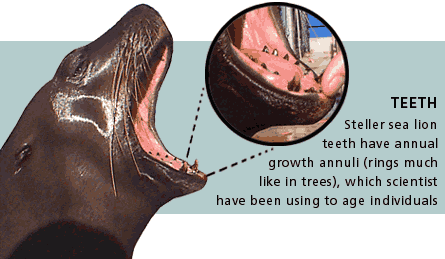
The teeth of sea lions have annual growth annuli (rings much like in trees),
which scientists have been using to age individuals. However, Dr. David
Sampson (OSU) thinks that the chemical composition of the teeth can yield
even more information. His idea is that changes in the physical or chemical
structure of the teeth can be used to date specific life-history events,
such as weaning, the onset of maturity, or age at first lactation. Dr.
Roger Nielson (OSU) has been using an electron microprobe to measure the
elemental micro-composition of teeth obtained from dead Steller sea lions
and from the National Marine Mammal Laboratory (NMFS). This initial study
will determine whether archived teeth can be used to reconstruct changes
in life history parameters which may provide insight into what happened
to Steller sea lions. NEXT:
Predation and the decline of the steller sea lion population>>>

|